
How to Clean and Care for Refinished Cabinets
A freshly refinished kitchen is one of the most satisfying upgrades a home can get. Keeping it looking that way is mostly about two things: giving the finish enough time to harden, and using gentle cleaning instead of aggressive cleaning.
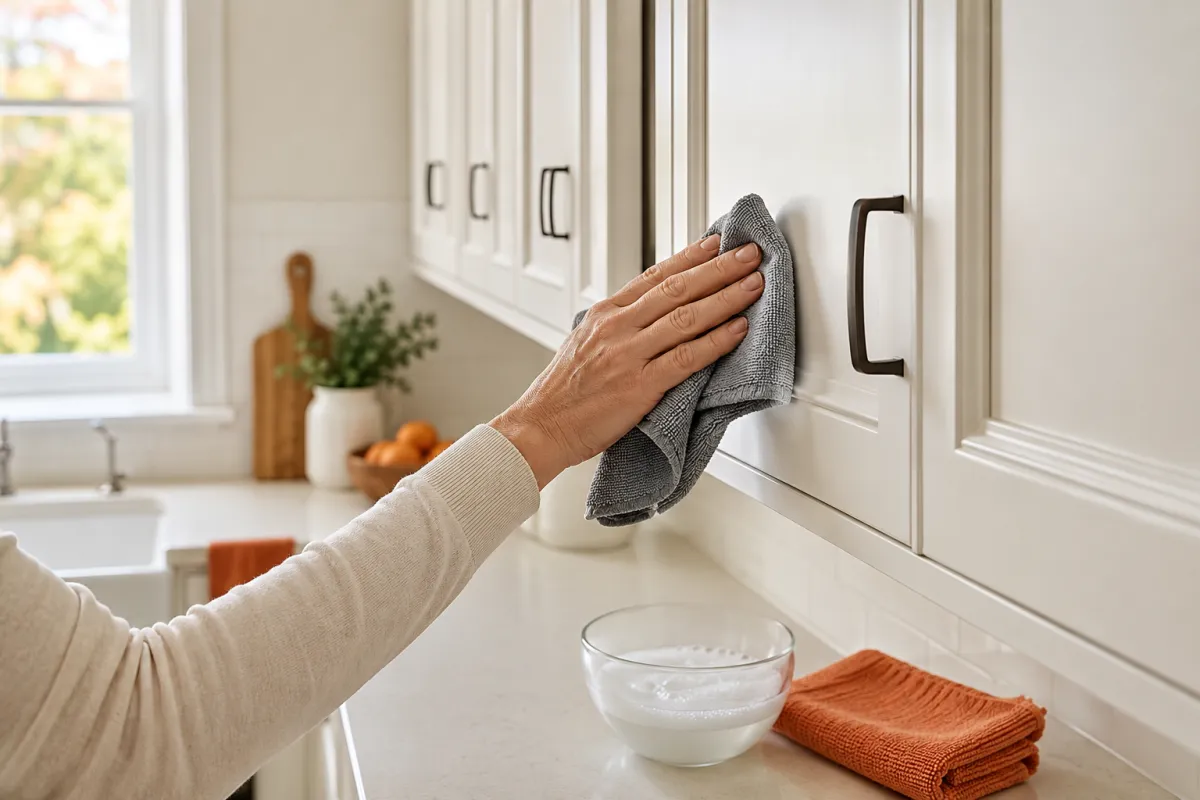
If you only take one thing from this article, take this. To clean painted kitchen cabinets, wipe with a damp microfiber cloth and mild dish soap, then dry the surface. That routine handles the vast majority of kitchen grime without risking the finish.
Here is the full picture, including what to avoid and how to deal with the inevitable small damage.
FIRST, UNDERSTAND CURE TIME
Dry and cured are not the same thing. A cabinet coating is dry to the touch within hours, but the film keeps hardening for weeks as it fully cross-links.
During that early period the finish is at its most vulnerable. Practical guidance for the first few weeks after a cabinet painting or refinishing project:
- Close doors and drawers gently rather than letting them swing shut
- Do not stick contact paper, shelf liner or adhesive hooks to painted surfaces
- Avoid stacking heavy items directly against door faces
- Skip all chemical cleaning, since a dry or barely damp cloth is enough
- Do not apply wax, polish or restorer products
Ask your finisher for the specific cure guidance on the product they used, since it varies by coating system.
THE ROUTINE THAT KEEPS CABINETS LOOKING NEW
Weekly Wipe-Down
1. Mix a few drops of mild dish soap into warm water.
2. Dampen a microfiber cloth and wring it out well, so the cloth is damp and never dripping.
3. Wipe with the grain or in the direction of the door's longest dimension.
4. Rinse with a second cloth dampened in plain water.
5. Dry immediately with a third dry cloth.
That final drying step matters more than people realize. Standing moisture is the single most common cause of finish failure at door edges and seams.
Focus on the High-Wear Zones
Some areas need attention far more often than the cabinet faces as a whole:
- Around handles and pulls, where skin oils build up fastest
- The cabinet beside and above the range, where airborne cooking grease settles
- The sink base doors and the toe kick beneath, which take constant water splash
- The trash pull-out and the door beside it, which see frequent contact and spills
- The doors nearest the dishwasher, since steam release is a real hazard, so crack the dishwasher open only after the cycle has cooled
WHAT NOT TO USE ON PAINTED CABINETS
Avoid these entirely, even on stubborn spots:
- Melamine foam erasers, which are fine abrasives and will dull or thin the finish
- Ammonia-based glass cleaners and all-purpose sprays containing ammonia
- Bleach or bleach-containing wipes
- Undiluted vinegar, which is acidic enough to affect some coatings over time
- Scouring powders, steel wool and abrasive sponges
- Oil soaps and furniture polish, which leave residue that interferes with any future touch-up or recoat
- Disinfecting wipes used daily, since occasional use on a durable finish is usually tolerable but repeated use is not
For dried-on grease, lay a warm damp cloth over the spot for a minute to soften it, then wipe. Patience beats scrubbing.
SMALL HABITS THAT PREVENT BIG DAMAGE
Add Soft Bumpers
Self-adhesive felt or clear silicone bumpers at door and drawer corners stop the finish-on-finish contact that eventually causes wear marks. They cost very little and are one of the highest-value things you can do.
Manage Steam
Steam is harder on cabinet finishes than most cleaners. Use the range hood when cooking, and be mindful of kettles, slow cookers and pressure cookers positioned directly beneath an upper cabinet.
Check Your Hardware
Loose pulls cause the door to twist slightly each time it is opened, which concentrates stress on the finish and the hinge screw. Tighten hardware once or twice a year.
Adjust Hinges When Doors Drift
European-style hinges have adjustment screws for depth and alignment. Doors that rub against each other will wear through the finish at the contact point, so realign them as soon as you notice contact.
Watch for Seasonal Movement
Wood doors expand and contract with seasonal humidity changes. On five-piece doors, a faint line can appear at the joint between the center panel and the frame during dry winter months.
That is normal wood movement rather than a finish failure, and it often becomes less visible as humidity rises again.
HANDLING CHIPS AND TOUCH-UPS
Small chips happen in busy kitchens. Deal with them early, before moisture reaches the substrate.
1. Clean the area gently and let it dry completely.
2. Lightly smooth any raised edge around the chip.
3. Apply a small amount of matching finish with a fine artist's brush, building thin layers rather than one thick dab.
4. Let each layer set before adding the next.
Keep a small labeled container of the exact finish used on your cabinets, along with the product name and sheen. If touch-ups on a door face become visible, refinishing that single door is usually straightforward.
KEEPING THE RESULT LONG-TERM
Cabinet finishes fail from moisture, abrasion and harsh chemicals, and almost never from ordinary use. Give the coating time to cure, clean gently and dry promptly, protect the high-contact points, and address chips while they are small.
Done consistently, that routine takes a few minutes a week and keeps a refinished kitchen looking current for years.
"Cabinets rarely wear out from cooking. They wear out from the cleaner someone reached for to clean up after it."
If your cabinets are structurally sound but the finish has had its day, cabinet refinishing is usually the practical route. Advanced Painting Professionals serves homeowners throughout Old Forge, Scranton and the surrounding counties. Call (570) 290-8471 or tell us about your kitchen at https://advancedpaintingprofessionals.com.
FREQUENTLY ASKED QUESTIONS (FAQs)
Q: Why did a thin line appear where the door panel meets the frame?
A: On solid wood five-piece doors, the center panel floats so it can move with humidity. When it contracts in dry weather, a hairline of unfinished wood can show at the joint. It is expected behavior rather than a defect in the finish.
Q: Can I use disinfecting wipes on cabinet doors during cold season?
A: Occasional use on a fully cured, durable finish is generally acceptable. Wipe the residue off with a plain damp cloth afterward and dry it, and do not make it a daily habit.
Q: When is it safe to put shelf liner inside refinished cabinets?
A: Wait until the finish is fully cured, and choose a non-adhesive liner. Adhesive liners can pull the coating when removed even months later.
Q: Do refinished cabinets need waxing or polishing?
A: No. Modern cabinet coatings are designed to be cleaned rather than conditioned. Polishes and oils build up residue and complicate future repairs.
