How Long Does Exterior Paint Last in PA Weather?
Most homeowners expect a single number, but exterior paint does not have one lifespan. It has several, and they differ from wall to wall on the same house. A sheltered north elevation can look fine while the sun-baked south wall is chalking and cracking.
Broadly, a properly prepared exterior finish on sound siding lasts several years to well over a decade. Where your home lands in that range depends on the substrate, exposure, the quality of the previous prep and how the surface is maintained.
Here is what actually controls how long exterior paint lasts in Northeast Pennsylvania, and how to tell when it is time to repaint.
WHY PENNSYLVANIA WEATHER IS DEMANDING
Our climate cycles hard. Siding expands in summer humidity and contracts in winter cold, and the freeze-thaw pattern works water into every gap it can find.
That movement is why caulk joints, end grain and horizontal surfaces fail first. Water gets behind the film, then freezing expands it, and the coating loses its grip from below rather than wearing away from above.
Add summer UV, seasonal wind-driven rain and shaded areas that stay damp long enough to grow mildew, and you have a fairly complete list of the forces working against your paint.
WHAT DETERMINES EXTERIOR PAINT LIFESPAN
Substrate
- Wood siding and trim move the most with moisture and need the most attention, particularly at butt joints and end cuts.
- Fiber cement is dimensionally stable and typically holds a coating well when joints and cut edges are properly sealed.
- Stucco and masonry need breathable coatings, since trapping moisture behind a film causes it to lift in sheets.
- Aluminum and vinyl siding hold paint when correctly prepped, though vinyl has color-related limits worth understanding before choosing a shade.
Sun Exposure
South and west elevations take the most ultraviolet load and consistently fade and chalk before the rest of the house. It is normal for those walls to need attention a few years before the north side does.
Homes on open lots weather faster than homes shaded by mature trees, though shade brings its own issue in the form of mildew.
Original Preparation
This is the factor homeowners underestimate most. Paint applied over dirty, chalky, damp or glossy surfaces has a short life regardless of what the can cost.
If a previous repaint peeled within a couple of seasons, the cause is almost always prep or moisture, not the product.
Color and Sheen
Deep, saturated colors fade faster under UV. Higher-sheen finishes shed water better and clean more easily, which is why trim is often specified at a higher sheen than the body.
Moisture Sources You Cannot See
Failed gutters, downspouts discharging against the wall, missing kick-out flashing, sprinklers hitting siding, and interior humidity venting into wall cavities will all destroy exterior paint from behind. Repainting without fixing them just resets the clock on the same failure.
SIGNS YOUR EXTERIOR PAINT IS NEARING THE END
- Chalking: a powdery residue on your hand after wiping the siding
- Fading that is noticeably uneven between elevations
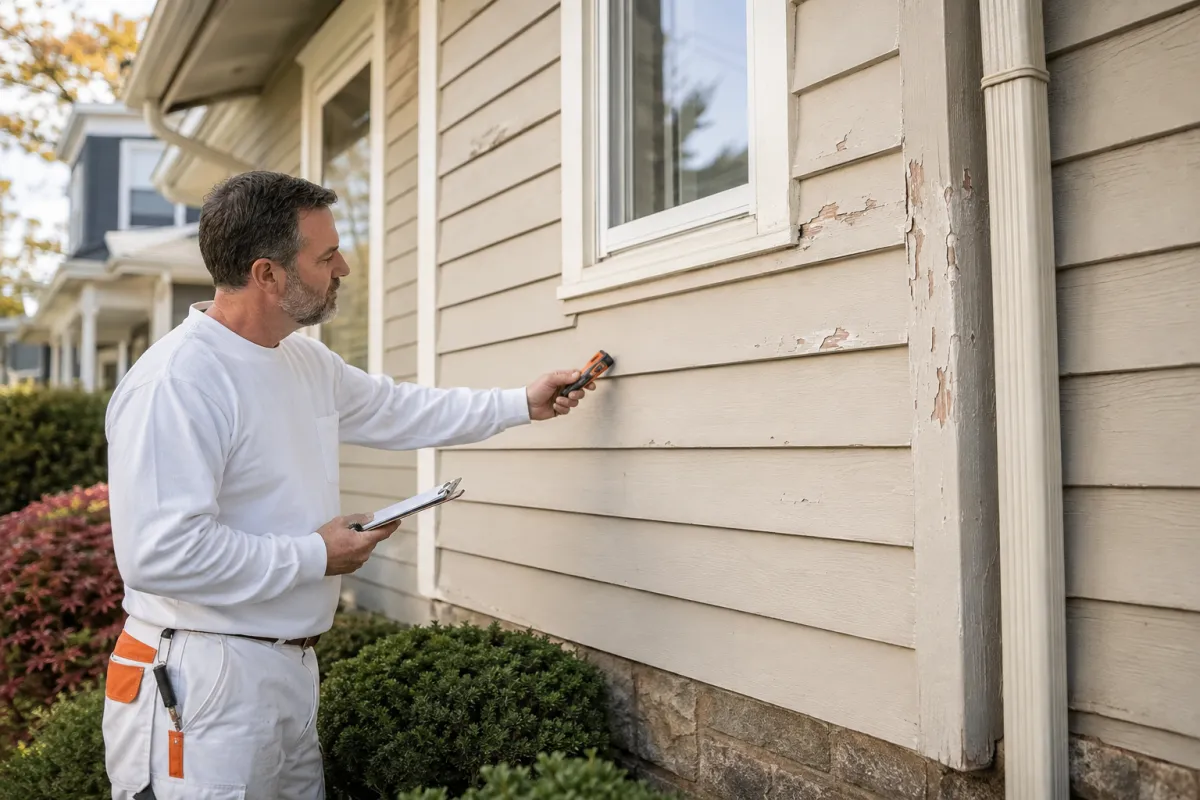
- Hairline cracking or an alligatored surface texture
- Caulk joints that have split, shrunk or pulled away
- Peeling or blistering, especially in patches rather than uniformly
- Bare wood showing at trim ends, window sills or corner boards
- Persistent mildew on shaded walls that returns quickly after washing
Peeling in one concentrated area usually points to a water source rather than a general end of life. That spot should be diagnosed before the whole house is repainted.
MAINTENANCE THAT ADDS YEARS
1. Wash the exterior periodically. Removing dirt, pollen and mildew slows degradation and keeps the surface looking uniform. Gentle washing is safer than high pressure, which can drive water behind siding.
2. Keep gutters clear and downspouts extended so water is discharged away from the walls.
3. Trim back vegetation so shrubs and branches are not holding moisture against the siding.
4. Inspect caulk yearly at windows, doors, trim joints and corner boards, and reseal where it has opened.
5. Touch up bare spots promptly. A small area of exposed wood becomes a large repair once water gets in.
6. Address the sunny elevations early. Repainting one or two exposed walls on their own schedule is a legitimate strategy, and planning it around the best season for exterior work gives the finish its best start.
REPAINT THE WHOLE HOUSE, OR JUST ONE SIDE?
If the finish is generally sound and only the south or west walls have degraded, a partial repaint can be a sensible interim step. The tradeoff is color match, since an aged finish and a fresh one will differ slightly even from the same formula.
When multiple elevations are chalking, caulk has failed broadly, or bare substrate is showing in several places, a full exterior painting project with proper prep gives the better long-term result.
THE BOTTOM LINE
How long exterior paint lasts comes down to substrate, exposure, preparation and maintenance rather than the label on the can alone. In Pennsylvania's freeze-thaw climate, the joints and horizontal surfaces tell you more about remaining life than the flat siding does.
Inspect once a year, keep water moving away from the house, wash the surfaces, and repair small failures while they are still small. Do that and you will get meaningfully more years out of every repaint cycle.
"Exterior paint rarely dies of old age. It usually dies of water finding a way in at a joint nobody checked."
Advanced Painting Professionals can look at your siding, trim and caulk joints and tell you what needs attention now versus what can wait another season. We serve Old Forge, Scranton, and Lackawanna, Luzerne, Pike, Susquehanna and Wayne Counties. Call (570) 290-8471 or reach out at https://advancedpaintingprofessionals.com.
FREQUENTLY ASKED QUESTIONS (FAQs)
Q: Can new exterior paint be applied over chalking siding?
A: Only after the chalk is removed by washing and the surface is tested for residue. Painting over chalk is one of the most common causes of early peeling.
Q: Does pressure washing damage siding?
A: It can, at high pressure or the wrong angle, by forcing water behind siding and gouging soft wood. Lower-pressure washing with an appropriate cleaning solution is generally safer and just as effective.
Q: Is mildew on the north side a paint problem?
A: Not usually. Mildew grows where surfaces stay damp and shaded. Cleaning it off and improving airflow around the wall matters more than the coating itself, though mildew-resistant products help.
Q: Does painting over old oil-based exterior paint cause problems?
A: It can if the surface is glossy or chalky and no bonding primer is used. Identifying the existing coating type before repainting determines which primer is appropriate.
